
Warren County Previous Residents by Era
Previous residents research needs more than an address typed into a search box. The earliest solid link for a modern address is usually the Warren County Auditor Property Search, which returns the current county parcel context. From there, the parcel number, legal description, and recorded instrument trail lead backward through the Recorder. Historical household evidence takes a different route through the Records Center, the Warren County Genealogical Society, Klei Research Library, newspapers, census schedules, and dated maps.
| Source | Years or condition | Where held | What it can show |
|---|---|---|---|
| Auditor parcel card | Current assessment cycle | Auditor Property Search | Parcel, situs, assessed owner, legal description, and map link |
| Recorder deed index | Indexed through 1797 | Recorder / AVA land-record search | Recorded parties, instrument dates, and title-chain leads |
| Recorder imagery | Most images from April 20, 2016 onward | AVA, Recorder PDF, or counter | Document image when available, not universal image coverage |
| Records Center holdings | Historical material, generally 75 years or older | Index, request, or reading room | Older county tax, map, court, and related record leads |
| Federal census | Public schedules through 1950 | Census genealogy sources and local research collections | Dated household clue to compare with other evidence |
The table is an evidence sequence, not proof that every source names occupants. Deeds establish recorded transactions. An Auditor card establishes assessment context. A directory, census, newspaper, or probate source may give a dated household clue. Preserve each role separately, especially when the owner mailing address differs from the property situs.
Warren County Previous Residents Start With a Parcel
Enter the street number and street name in the Auditor address route, then confirm the returned situs is the address sought. Record the parcel number, legal description, municipality, township, assessment date, and any map connection. The Auditor maintains about 91,400 real-estate parcels and provides name, address, parcel ID, account number, subdivision or lot, and advanced routes. It is an assessment system, not a current-resident roster. An assessed owner may be a trust, entity, estate, or a person who receives tax mail elsewhere.
The Recorder's instructions identify the 10-digit parcel number as the bridge from an Auditor result to AVA. That is the strongest Warren County path for a property history because it reduces confusion between similar street names and similarly named parties. Use the official parcel map for orientation and jurisdiction context, but not as a boundary ruling. A colored map layer cannot resolve an easement, an old lot split, or a legal boundary question.
- Parcel number
- A county-specific identifier for the tract in the Auditor and GIS systems. It is the local bridge to land documents, not a universal record number.
- Situs address
- The property location used on the county parcel record. It differs from a tax-mailing address.
- Legal description
- The recorded land wording, such as a lot, tract, survey, or metes-and-bounds reference. It often survives an address change better than a street number.
Tracing Warren County Previous Owners by Deed
The Warren County Recorder's AVA search instructions state that deeds are indexed online through 1797 and that the system has more than five million recorded documents. Begin with the newest conveyance that matches the parcel and legal description. Read the document for grantor, grantee, instrument or recording number, deed date, and any stated prior reference. Then use the grantor or predecessor reference to find the earlier conveyance. Repeat one transaction at a time.
- Pull the current Auditor parcel card and retain its situs, parcel number, legal description, owner label, and processing date.
- Search AVA with the Recorder-recommended 10-digit parcel number, then locate the newest matching conveyance.
- Record the grantor, grantee, document date, instrument number, and prior-reference recital exactly as shown.
- Search the predecessor party or cited instrument for the next earlier transfer, checking the legal description at each step.
- When a result is missing or the tract changes, use the Recorder counter, volume or page clues, recorded plat, and Records Center material rather than guessing.
- Grantor and grantee
- The grantor conveys an interest in the recorded instrument; the grantee receives that stated interest.
- Chain of title
- A dated sequence of recorded transfers for the same land interest. It is not a list of every occupant.
- Instrument number
- The Recorder's reference for a recorded document, useful when requesting a specific copy.
A parcel can be split, combined, replatted, transferred through an estate, or described under a former legal description. Compare acreage, lot or block, subdivision name, survey wording, and prior references before deciding two documents concern the same land. A sale amount can be an event clue, but it does not establish the land's full scope, a relationship, or occupancy.
Warren County Previous Residents and Online Images
The Recorder says most document images are online from April 20, 2016. The word “most” matters. An index hit, an online image, and a complete historic copy are three different things. For a document that is not visible, give the Recorder the instrument number when known. Otherwise provide the parcel, party name, approximate recording date, and document type, then ask whether an ordinary, certified, or authenticated copy is available and what the current charge is.
The Warren County historical records request route is shown below.
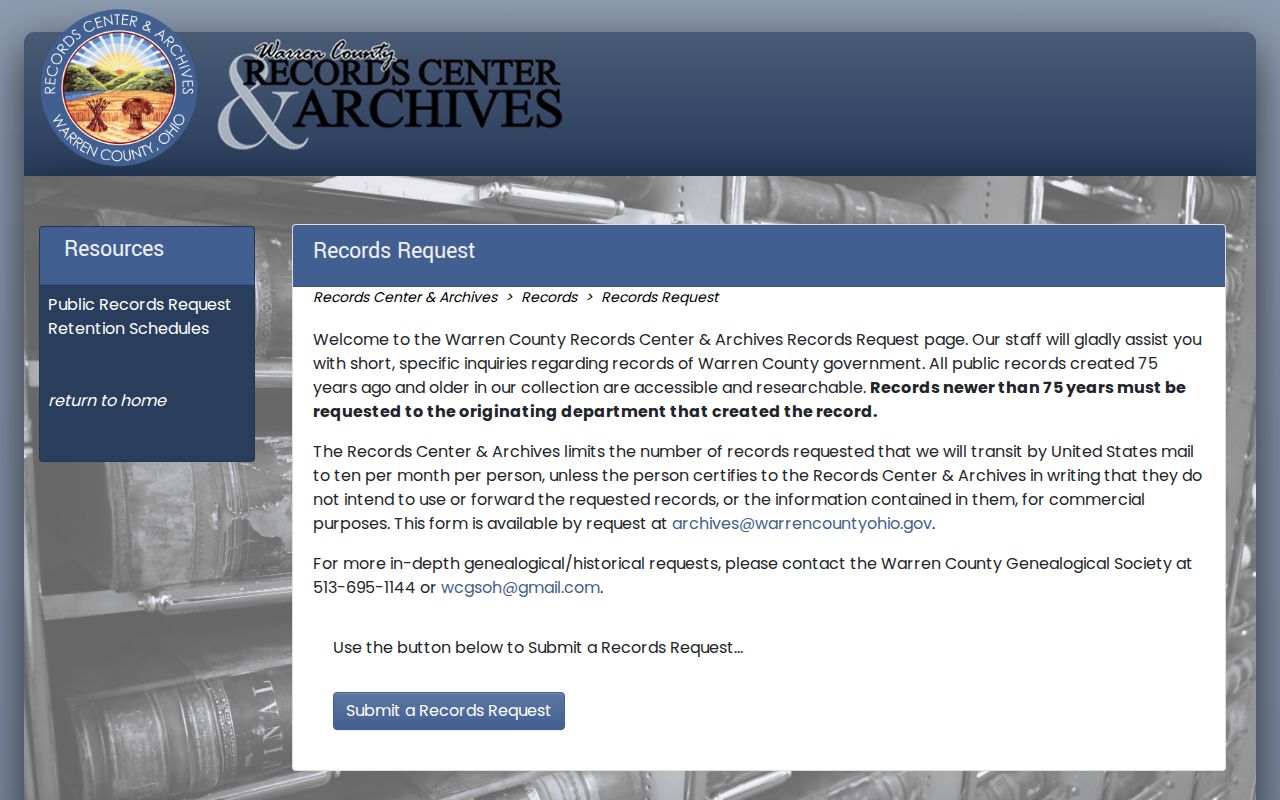
A focused request uses the form's own indexing language: department, record type, township, party name, date, and relevant additional detail. That approach helps the custodian route a historic question without treating an address as a complete identity.
Warren County Previous Residents Household Clues
Owners are only one part of an address history. For a dated household lead, pair a directory or newspaper reference with a census schedule, Probate material, a deed, or a vital-record source. The locally identified directory is Wiggins & McKillop's Directory of Warren County for 1878. The research did not verify a complete local city-directory run or a reverse-directory title and date, so no broader directory shelf should be assumed. The collections and their access routes are described on the Warren County city directory page.
- Choose a directory, newspaper, or census item nearest the property event date and transcribe the address or locality exactly as printed.
- Compare it with the closest public census year, which currently reaches through 1950, and retain each source's date and page or reference.
- Use an obituary, estate notice, Probate file, or vital index as a lead to the custodian record, not as stand-alone proof of identity.
- When two sources disagree, test the next nearby year, an alternate spelling, a former legal description, or a township source.
The Western Star project is especially useful for a dated local lead. WCGS reports 178,510 digitized pages in 9,909 issues, with title changes and gaps. Search by name, town, address wording, and date range. A notice can point toward a Recorder, Probate, court, or vital source, but a missing issue or an OCR no-result cannot decide the question.
Warren County Historic Map Context
Sanborn maps show the built setting around a past address. The local map guide identifies editions for Franklin, Lebanon, Mason, Morrow, and Waynesville. Lebanon has listed editions beginning in 1885 and extending through a 1923 to 1941 volume. A map can show a building footprint, street layout, or business use for that map year. It does not identify current owners, settle a boundary, or establish a household.
The Ohio Web Library's Lebanon 1890 Sanborn map is pictured below.
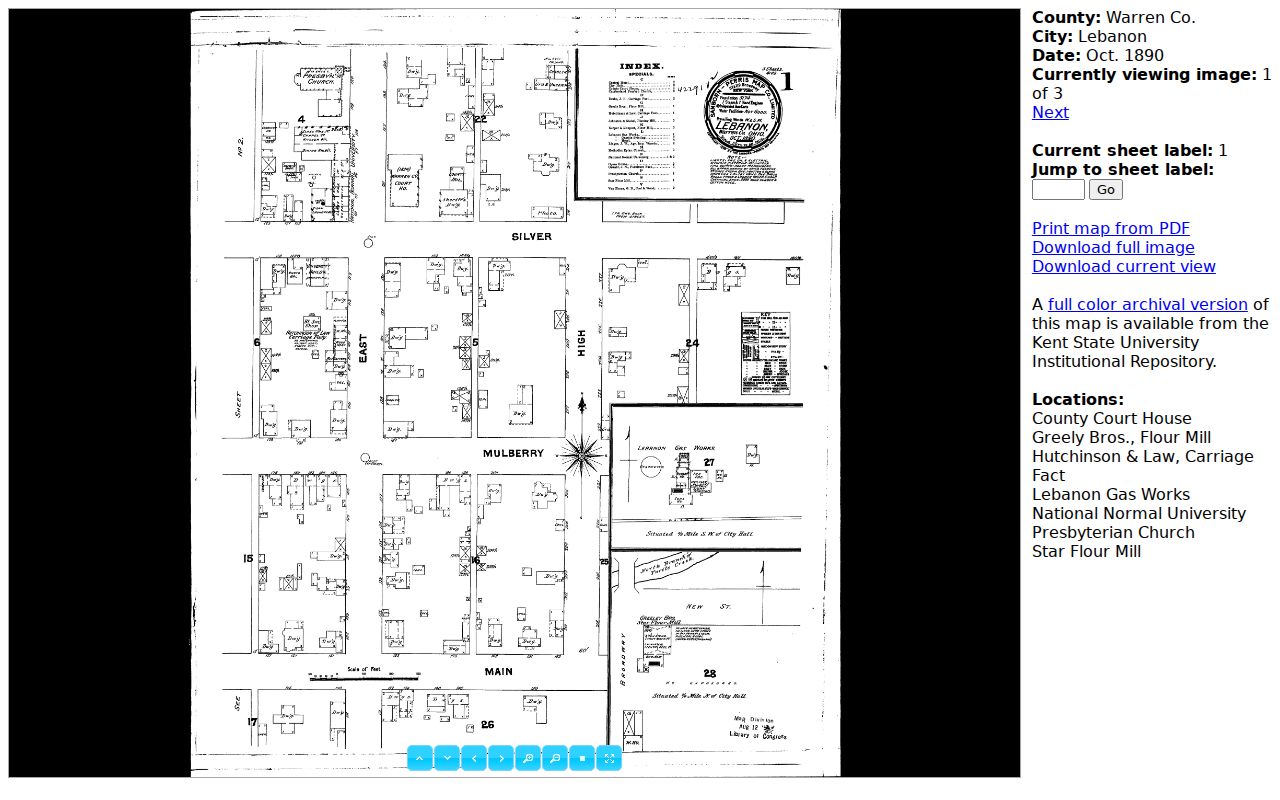
Use a map year alongside a directory year and a recorded land reference. That comparison can explain a building or road context without claiming that the map names a resident.
Warren County Archive Research Channels
The Records Center & Archives preserves county material back to 1803 and uses a firm 75-year workflow: historical collection material is accessible there, while newer records go to the creating department. Its archives index, request process, reading room, and copying rules are distinct access channels. The center permits no-flash photographs but has preservation rules for fragile materials, and it limits mail transmittals to ten records each month without noncommercial certification.
The Warren County Historical Society documents collection is shown below.
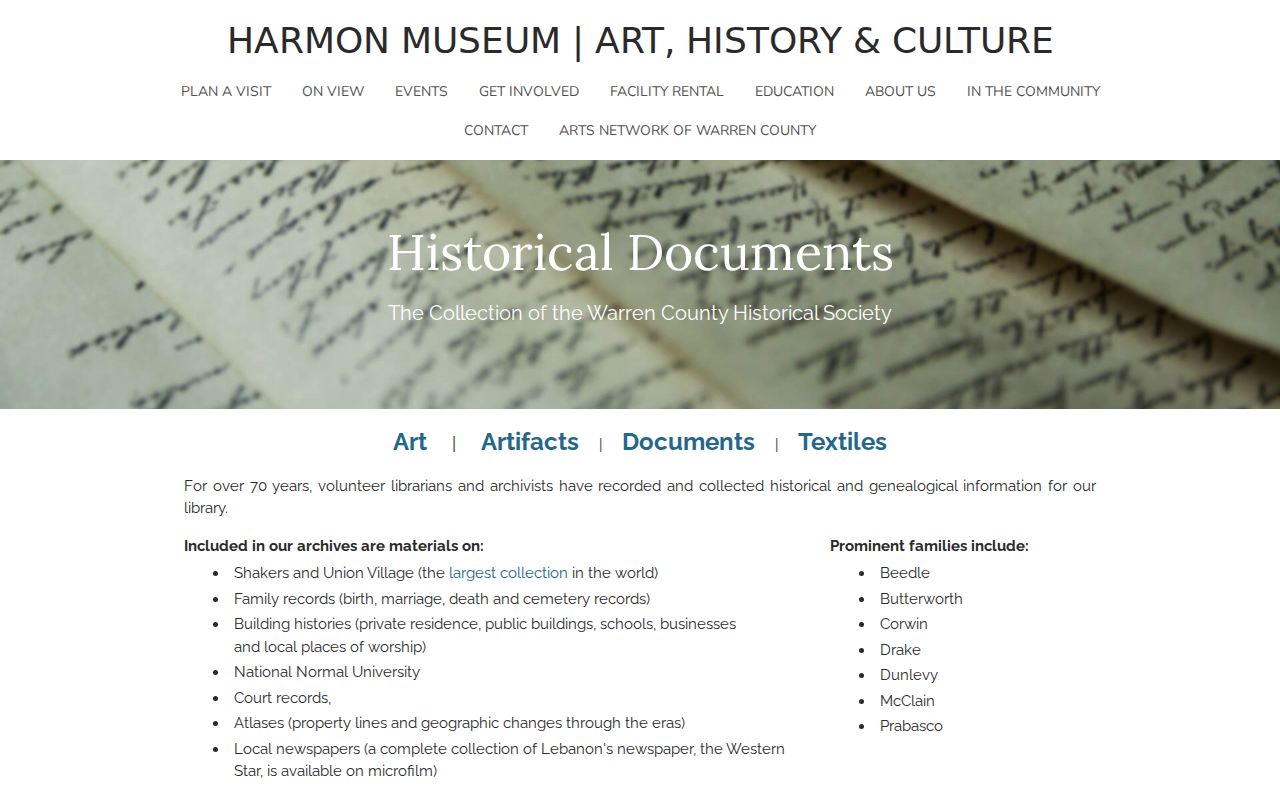
Klei Research Library adds property histories, atlases, local newspapers, churches, cemetery resources, photographs, and court material. The Warren County Genealogical Society's library and online research route offer another local channel. A scoped request should give the known names, date, record type, time period, contact method, and a limit for paid staff research where applicable.
Warren County Historical Vital Leads
Historical vital research provides a date anchor, not a complete address history. The Warren County Genealogical Society identifies local birth and death research for 1868 through 1909. For later state archival death work, the Ohio History Connection index has cited searchable eras of 1913 to 1944 and 1954 to 1970. A historical index can help locate a certificate or related county record, but it is not legal certification.
The Warren County Genealogical Society vital-record guide is pictured below.
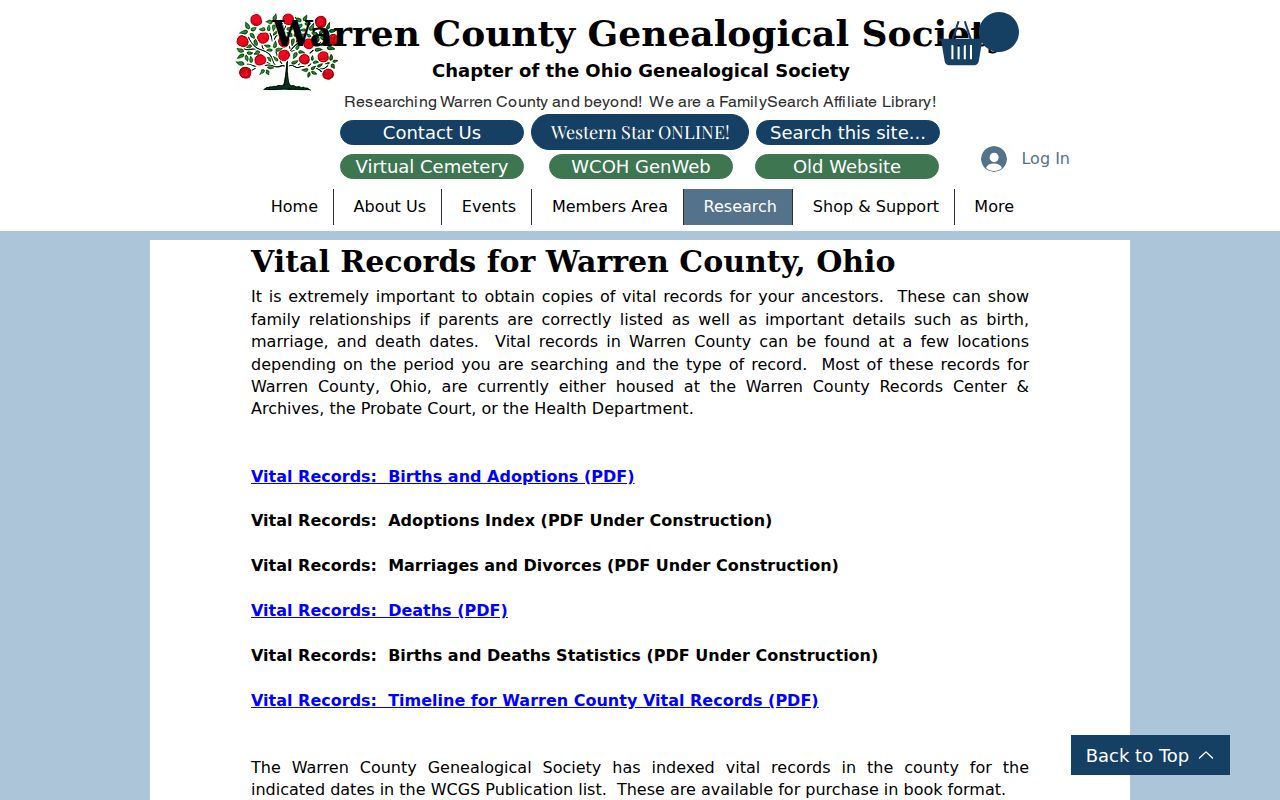
For a current certificate route, the Health District handles Ohio births from 1909 to the present and Warren County deaths from 1909 to the present under its stated rules. Keep that certified-record channel separate from an archival index or a family-history note.
Warren County Historic Land Descriptions
Old Warren County deeds may use a legal description that does not resemble a modern lot number. The county's early land record context includes the Virginia Military District, Symmes Purchase, and Congress Lands. A historic document may refer to a survey, range, section, tract, or metes-and-bounds line. Start with the wording on the record, then compare a plat or historic map. Do not retrofit it to a current subdivision because a street name appears familiar.
Warren County was organized in 1803, and its recorded land history reaches earlier transactions. That long index is a valuable local advantage, but a current parcel may still be a later split or combination. Record the historical description and its source date beside the current parcel number, then connect them only with a documented plat, map, index, or custodian response.
Warren County Previous Residents Without Guessing
Previous residents research is strongest when it records uncertainty. If a directory entry, deed party, census household, and newspaper notice cannot be reconciled by name, date, locality, and address or legal description, identify a possible match and the next source to check. Do not fill a gap with a street renumbering theory. No authoritative countywide renumbering manual was identified in the research. For a disputed old address, ask the Records Center, historical society, or municipal engineering office for a dated map or numbering record.
Lawful use. Use Warren County house-history records for family history, estate questions, and personal curiosity. Never use older records to harass, track, or endanger a living person.
Note: A dated deed, directory, newspaper, map, or census clue should be kept as its own record relationship until another source confirms the connection.